

Is this for my dog?
You might be in the right place if...
Your dog lunges, barks, or reacts before you can even think
Walks feel like something to survive, not enjoy
Fear or anxiety is quietly running your dog's whole life
Your dog falls apart when left alone
Having guests over means managing a crisis
You've tried things before and nothing has stuck
Behavior work needs more than quick fixes.
Most training focuses on what the dog is doing wrong. I start somewhere different.
Behavior Assessment
Understanding why a behavior is happening is the only path to changing it. We don't skip this step.
Practical Plans
Every client receives a structured, real-life plan built around your dog, your home, and your daily routine. Not generic exercises.
Owner Guidance
Here's what most trainers won't tell you: the biggest variable in your dog's behavior is you. I'll guide you through that honestly, without judgment.
You've probably already tried a few things.
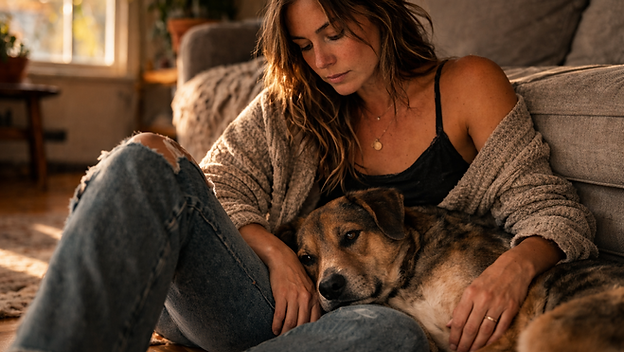
Maybe you've watched the videos, read the articles, or even worked with a trainer before. And maybe it helped a little, or not at all. That's not a failure on your part. Most behavior support doesn't go deep enough.
Harmonious Handling is built for owners who are ready to actually understand what's driving their dog's behavior, not just manage it. We work virtually, which means I get to see your dog in the environment where the behavior actually lives, not just in a training facility where everything looks fine.
Why virtual consulting works especially well for complex behavior cases.
If your dog struggles with reactivity, fear, or anxiety, virtual isn't a compromise. For this kind of work, it's often the better fit.
Here's why.
Your dog stays in their actual environment.
Bringing a stranger into the home, or taking a fearful dog somewhere unfamiliar, can push them over threshold before a session even begins. What you end up with is a dog in survival mode, not a real picture of their behavior. Virtual sessions remove that disruption entirely. Your dog is relaxed, you're relaxed, and what I'm seeing is real.
I see the real dynamic between you and your dog.
This is the part most people don't expect. When an unfamiliar person is physically in the room, everything shifts — how you hold the leash, how you talk to your dog, how your dog reads you. On a video call, that performance layer drops away. I get to see what's actually happening between the two of you, which is where the most important work lives.
You get access to the right specialist, not just the nearest one.
Complex behavior cases require a specific depth of knowledge in learning theory, emotional regulation, and behavior modification. That expertise isn't always available locally. Virtual consulting means geography doesn't determine the quality of support your dog gets.
Everyone in the household can be part of it.
Behavior change doesn't stick when only one person in the home knows the plan. Virtual sessions make it easy for partners, family members, and anyone else who handles your dog to be present and on the same page, without anyone having to rearrange their day around a home visit.
Hi, I'm Melissa.

I've spent over six years working with dogs whose owners were told they were broken, stubborn, or beyond help. They weren't.
I don't come into a case with a rigid method I apply to everyone. No two dogs are the same, and no two owners are either. What I bring is the ability to look at the dog and person in front of me and build something that actually works for both of them.
Education is at the center of everything I do. When owners understand why their dog does what they do, what's driving the behavior, what the dog is actually communicating, how enrichment and the right activities can shift things over time, everything changes. Knowledge isn't just helpful here. It's the whole foundation.
A lot of the dogs I work with have never truly understood a word coming out of their owner's mouth. And a lot of owners have never been taught how to communicate in a way their dog can actually receive. So we work on both sides at once. Dogs learn how to learn. Owners learn how to teach. And somewhere in that process, something shifts.
Complex behavior problems are emotional responses. They're valid. They make sense when you understand where they come from. My job is to help you understand that, set real expectations for what change looks like, and build a plan that fits your life.
And along the way, we find the easy wins. The small moments that feel like progress. Because when a dog and their owner start to feel successful together, something bigger starts to happen. Joy comes back. Trust gets rebuilt. That's what this work is really about.
I keep my caseload small on purpose. Everyone who works with me gets my full attention and the support to keep going between sessions.